
The Game of Milliseconds: In-Depth Analysis of Factors Affecting Industrial HF RFID Read/Write Speed and WELLAUTO 's Efficient Solution
Solution August 7, 2026
In Industry 4.0 smart factories, RFID is like the "nerve endings" of equipment. However, many engineers are puzzled: why is my production line's read/write speed so slow, even though the nominal frequency is 13.56MHz? Why does it frequently report errors in complex environments?
The read/write time of industrial high-frequency (HF) RFID is never a fixed value; it's ahardware performance, environmental media, and communication protocols. Today, we'll delve into the core factors affecting read/write speed and seeWELLAUTOhas emerged victorious in this game.
I. Five "Hidden Killers" Affecting Read and Write Speed
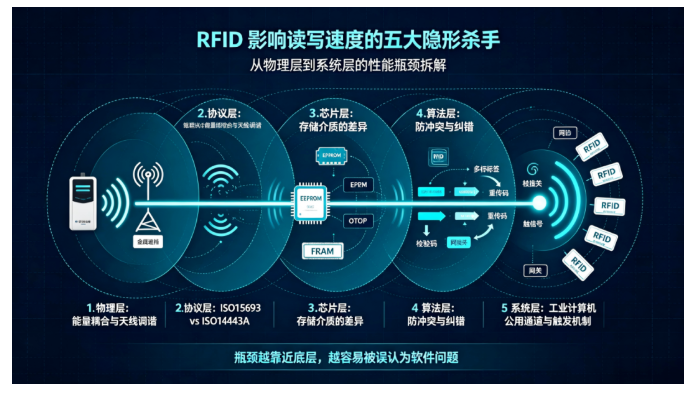
1. Physical Layer: Energy Coupling and Antenna Tuning
HF RFID works based on the principle of electromagnetic induction, and the reader antenna and the tag coil form a coupling transformer
•Q-factor and detuning: The quality factor (Q-factor) of an antenna determines the efficiency of energy transmission. A high Q-factor, while providing a long read distance, results in a narrow bandwidth and susceptibility to temperature drift, leading to detuning. A low Q-factor results in insufficient energy and a short read/write distance.An excellent reader must possess an auto-tuning functionto match impedance in real time, ensuring optimal energy transmission under various environmental conditions.
•Coil area ratio: The ratio of the reader antenna area to the tag antenna area directly affects the coupling coefficient. An imbalance in the ratio will directly lead to read/write failures or a sharp drop in speed.
2. Protocol layer: ISO15693 vs ISO14443A
This is crucial for determining the air interface rate
•ISO14443A: Commonly used for access control cards and ID cards, with a transmission rate of 106kbit/s. Although it is fast in single-byte processing, it has poor anti-collision capability and is not suitable for dense group reading.
•ISO 15693: An industrial-grade standard with transmission rates up to 26 kbit/s (low speed) or even higher. Its biggest advantages arestrong anti-collision capabilitiesand longer read distances. WithWELLAUTO's optimization and efficient instruction encapsulation, ISO 15693 often achieves higher effective throughput in practical applications.
3. Chip layer: Differences in storage media
Don't underestimate that tiny label, the size of a fingernail; the "hard drive" technology inside determines the write speed
•EEPROM (Electrically Erasable Programmable Read-Only Memory): This is the most common type, but it requires an internal high-voltage pump during writing, and a single byte write typically takes several milliseconds to tens of milliseconds.
•FRAM (Ferroelectric Random Access Memory): The technology used in high-end tags, offering extremely fast write speeds (nanosecond level) and near-infinite read/write lifespan. If your application involves high-frequency data writing (such as tool life counting), you must choose a tag solution that supports FRAM.
4. Algorithm Layer: Collision Prevention and Error Correction
When there are multiple tags in the reader field, the efficiency of the anti-collision algorithm directly determines the group reading speed
•ALOHA algorithm vs. binary tree algorithm: The latter is far more efficient at recognizing a large number of tags. Furthermore, while mechanisms such as CRC checksum and forward error correction (FEC) increase data security, they also increase data processing time. Excellent firmware algorithms find the optimal balance between speed and accuracy.
5. System Layer: Industrial Bus and Triggering Mechanism
The RFID reader is just an intermediate step; the data is ultimately handed over to the PLC
•Bus latency: Traditional RS485/Modbus RTU communication has high latency, whileEtherCAT and Profinet IRTcan compress the communication cycle to the microsecond level.
•Trigger blind zone: Relying on the PLC to poll the reader's status will result in unnecessary waiting. UsingIO-Link event triggeringorphotoelectric sensor hardware interruptscan wake up the reader the moment it is triggered, greatly shortening the response time.
II. The Challenges of Harsh Environments: The "Double Strangulation" of Metal and Liquid
In automotive welding workshops or food and beverage bottling lines, environmental factors are often overlooked causes of deceleration
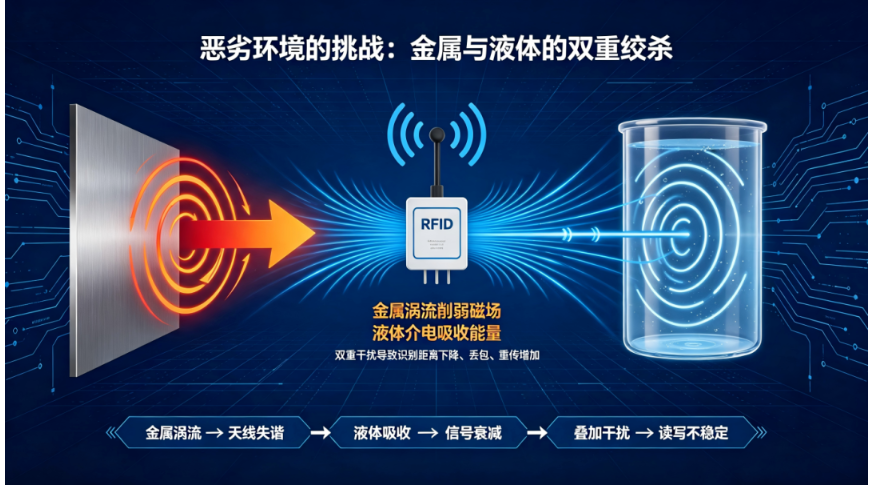
•Metal interference: The eddy current effect generated on the metal surface cancels out the magnetic field, causing the tag to become detuned or even unable to activate. When a regular tag is attached to metal, the reading and writing distance may drop drastically from tens of centimeters to just a few millimeters.
•Liquid absorption: Water (including the human body and electrolytes) can absorb electromagnetic wave energy of 13.56MHz.
Electromagneticnoise: Electromagnetic noise generated by frequency converters and high-power motors can cause data frame errors, forcing the reader to retransmit (retry), which increases the read and write time exponentially.
III. WELLAUTO 's High-Speed Read and Write Technology
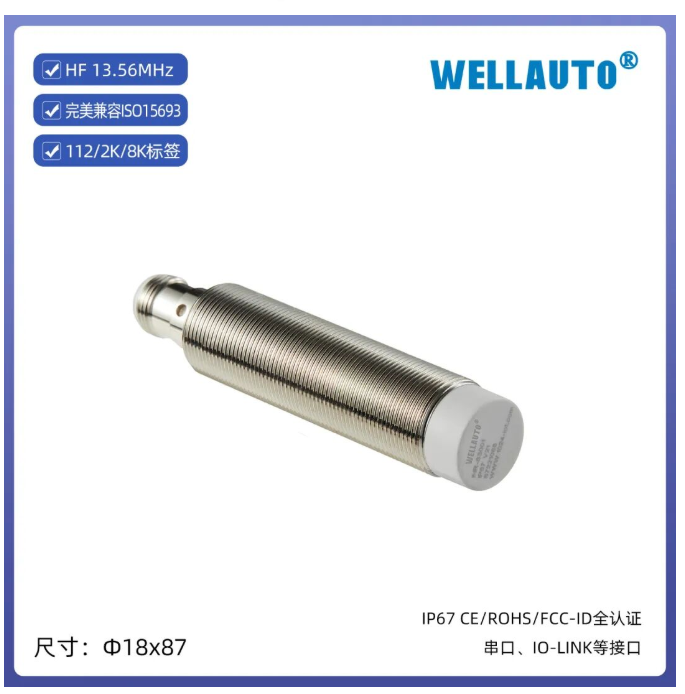
Addressing the aforementioned pain points, WELLAUTO AU3 IHR series high-frequency RFID system is not only "usable," but also designed for "extreme speed" and "stability."
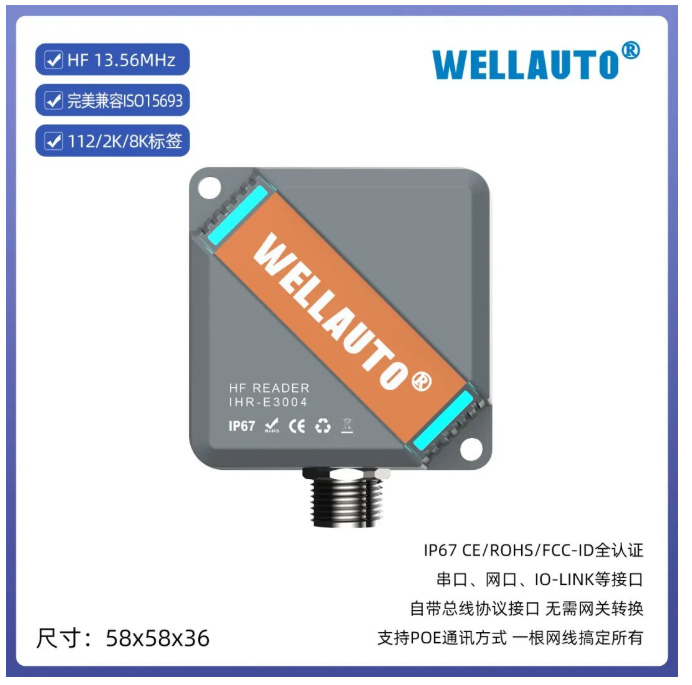
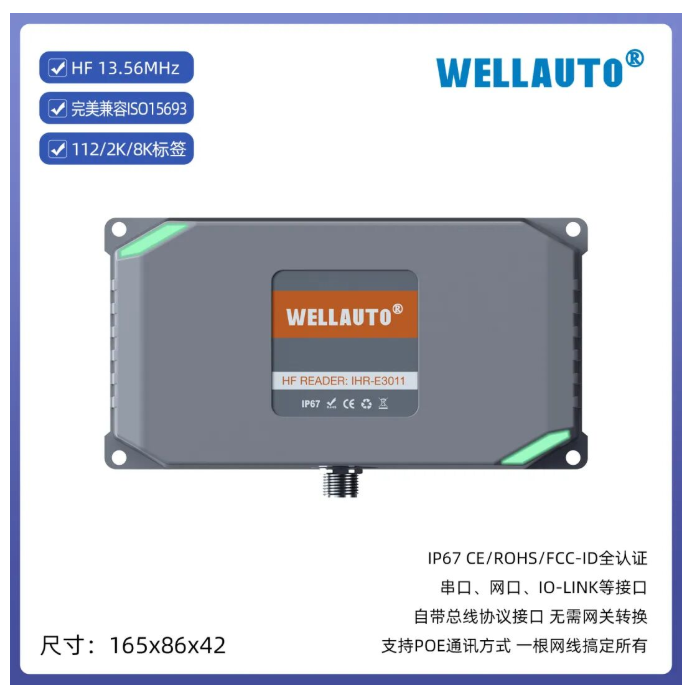
1. Core Performance: Defining Industrial-Grade Speed
•Ultra-high throughput: Relying on its self-developed baseband processing chip and optimized algorithms,WELLAUTOreader achievesup to 1500 Bytes/s. This means that in typical industrial applications, a single read operation takes only20-50ms, and a single write operation takes only50-150ms, easily keeping up with production line cycles of hundreds of operations per minute.
•Lightning-fast wake-up: Unique low-power listening technology enables the reader to wake up from sleep in less than milliseconds.
2. Anti-interference black technology: As stable as Mount Tai
•Adaptive Tuning Technology: WELLAUTOreaders can monitor antenna impedance changes in real time and dynamically adjust the resonant point. Whether near metal, switching between workpieces of different materials, or changes in ambient temperature, they maintain stable read/write performance.
Specialized Tag Design: AU3 IHT-TM series anti-metal tags are designed for metallic environments . Through a special ferrite magnetic shielding layer design and coil topology optimization, they not only solve the problem of "not reading when attached to metal," but also achieve a stable read/write distance of up to 220mm on metal surfaces , far exceeding the industry average.
3. Seamless integration: Eliminating bus bottlenecks
•Full bus coverage: Natively supportsProfinet, EtherCAT, EtherNet/IP, Modbus TCP, andIO-Link. No additional gateway converter is required; it directly connects to mainstream PLC systems such as Siemens, Omron, and Beckhoff.
•Data mapping technology: Directly maps RFID data to the input/output image area of the PLC, allowing RFID data to be read like ordinary I/O points, eliminating complex communication programming and greatly reducing CPU load and communication latency.
4. Extreme Durability: Capable of handling extreme working conditions
•Wide temperature range: Operating temperature range-40℃ to +85℃(some high-temperature labels can reach +220℃), suitable for extremely cold storage or high-temperature processing environments.
•IP68 & 360° Protection: The read/write head adopts laser welding or ultrasonic potting process to achieve IP68 protection level, which is not afraid of cutting fluid spray, oil corrosion and high-pressure water jet cleaning.
•Military-grade quality: It has passed rigorous ESD electrostatic discharge testing, pulse group anti-interference testing and tens of thousands of mechanical vibration tests to ensure reliable operation in high-vibration environments such as stamping and forging.
IV. Typical Application Cases: Visible Efficiency Improvements
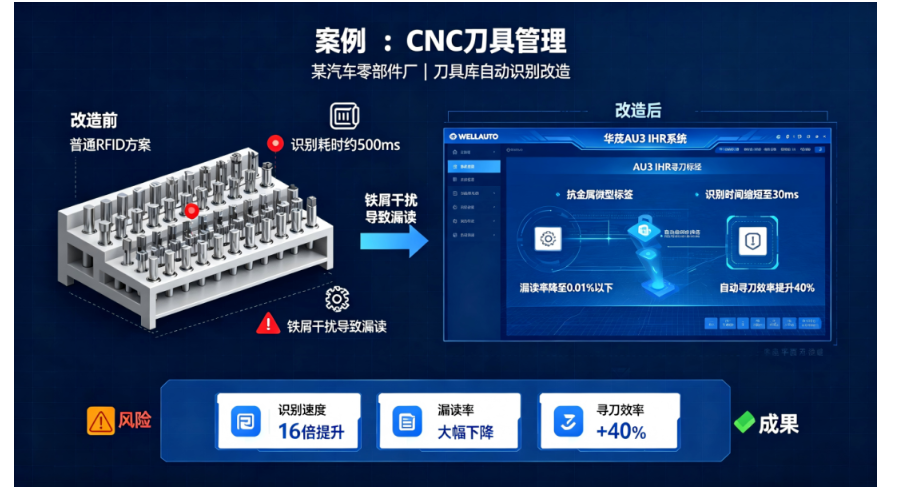
·Case 1: CNC Tool Management
A car parts factory previously used ordinary RFID tags, which took about 500ms to identify tool changes and were often missed due to interference from metal filings. After switching toWELLAUTOAU3 IHR system, in conjunction with anti-metal micro tags,the identification time was reduced to 30ms, the missed reading rate dropped to below 0.01%, and the efficiency of automatic tool magazine retrieval improved by 40%.
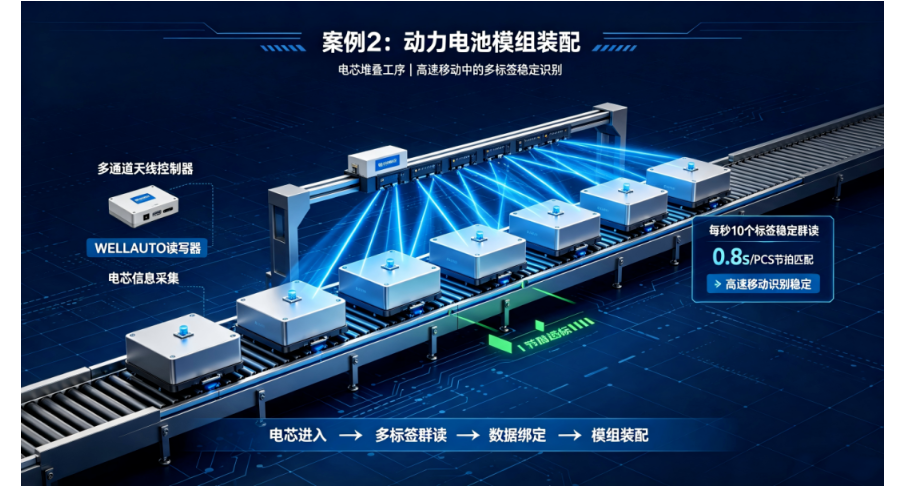
·Case 2: Power Battery Module Assembly
In the cell stacking process, information from multiple cells needs to be read while moving at high speed.WELLAUTOreader, in conjunction with a multi-channel antenna controller, achievesa stable group reading of 10 tags per second, perfectly matching the production line's cycle time requirement of 0.8s/PCS.
V. Selection Tips: How to find the optimal solution for your production line?
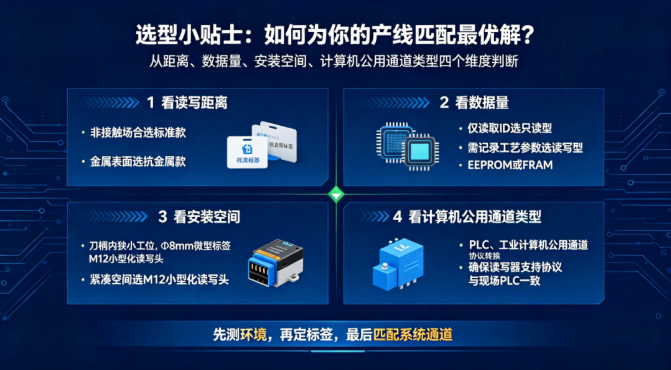
1.Check the read/write distance: Choose the standard model for non-contact applications and the anti-metal model for metal surfaces.
2.Check the data volume: If you only need to read the ID, select read-only type; if you need to record process parameters (such as torque and temperature), select read-write type (EEPROM or FRAM).
3.Consider the installation space: For narrow work areas (such as inside the tool holder), select Φ8mm micro tags and M12 miniaturized read/write heads.
4.Check the bus type: Ensure that the protocol supported by the reader is consistent with that of the PLC on site.
In the field of industrial automation, time is money, and stability is the lifeline. With its deep technological expertise and profound understanding of industrial environments, WELLAUTO has created RFID products that truly understand the "language of industry."

Related Articles
Bus temperature control is used in hot riveting machines
November 5, 2025![[Application Case] IP67 Application in Robot Workstations](https://www.wellauto.net/wp-content/uploads/2025/11/202511200620316.png)
[Application Case] IP67 Application in Robot Workstations
November 20, 2025
Application of card-type I/O modules in carton filling machines
November 5, 2025