From Eddy Current Suppression to Microstrip Patches: In-depth Analysis of the Differences in the Principles of Anti-Metal RFID Tags, and a Discussion of the Advantages of WELLAUTO Industrial-Grade Solutions
Solution July 24, 2026
In the practical implementation of Industry 4.0, RFID technology serves as the "eyes" for achieving end-to-end traceability. However, when these "eyes" encounter the ubiquitous metal in factories—whether it's the cutting tools of CNC machine tools, the molds in injection molding workshops, or the metal pallets of AGV carts—they often become "blind" instantly
Why do ordinary RFID tags struggle to move on metal surfaces? How do anti-metal tags solve this problem through special electromagnetic field manipulation technology? This article will start from the underlying electromagnetic principles, deeply compare the technical differences between anti-metal and non-anti-metal tags, and analyze WELLAUTO 's core strengths in the field of industrial RFID tags
I. In-depth analysis of the principle: Why do ordinary tags fail when they encounter metal? In the practical implementation of Industry 4.0, RFID technology is the "eye" for achieving full-process traceability. However, when these "eyes" encounter the ubiquitous metal in the factory—whether it is the cutting tools of CNC machine tools, the molds in the injection molding workshop, or the metal pallets of AGV carts—they often become "blind" instantly.
Why do ordinary RFID tags struggle to move on metal surfaces? How do anti-metal tags solve this problem through special electromagnetic field manipulation technology? This article will start from the underlying electromagnetic principles, deeply compare the technical differences between anti-metal and non-anti-metal tags, and analyze WELLAUTO 's core strengths in the field of industrial RFID tags
I. In-depth analysis of the principle: Why do ordinary labels become useless when they encounter "gold"?
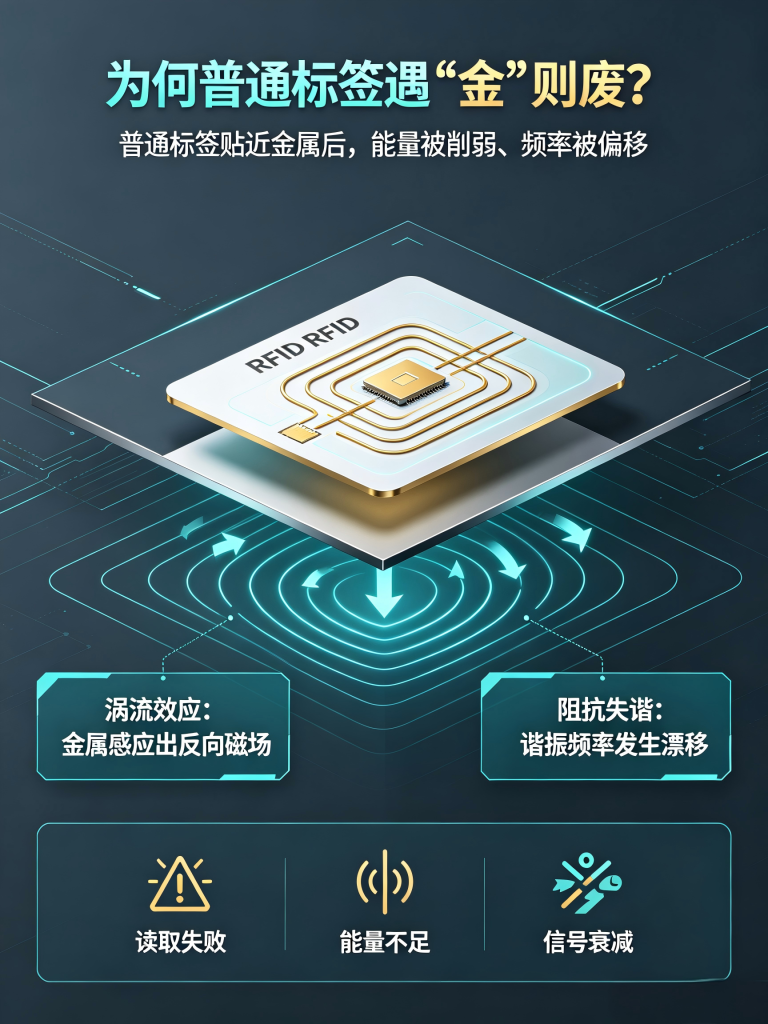
To understand anti-metal tags, we must first understand why ordinary tags fail. This mainly involves two key electromagnetic phenomena:the eddy current effectandimpedance detuning.
1. Vortex: A "black hole" of energy
Ordinary non-metallic tags (mostly dipole antennas or simple coils) operate in the air. When the tag is close to a metal surface, the antenna coil inside the tag is in a changing radio frequency magnetic field. According to Faraday's law of electromagnetic induction, a closed current loop will be induced inside the metal conductor; this is callededdy current.
Consequence :The eddy current generates a magnetic field in the opposite direction to the original magnetic field, canceling out the energy of the original magnetic field. This is like trying to catch water with your hand, but the water is being diverted by a funnel. As a result, the tag does not receive enough energy to activate the chip, leading to a read failure.
2. Impedance detuning: An "open circuit" in the circuit
RFID tags have strictimpedance matchingrequirements between their antennas and chips to achieve maximum energy transfer efficiency. The presence of metal can alter the dielectric constant and permeability around the antenna, causing a shift in the antenna's resonant frequency (typically towards lower frequencies).
Consequences :An antenna originally tuned to 13.56MHz may become 12MHz or lower on a metal surface, causing the energy emitted by the reader to be unable to be effectively received by the antenna, resulting in severe signal attenuation.
II. Technological Breakthrough: Three Core Methods of Anti-Metal Tags
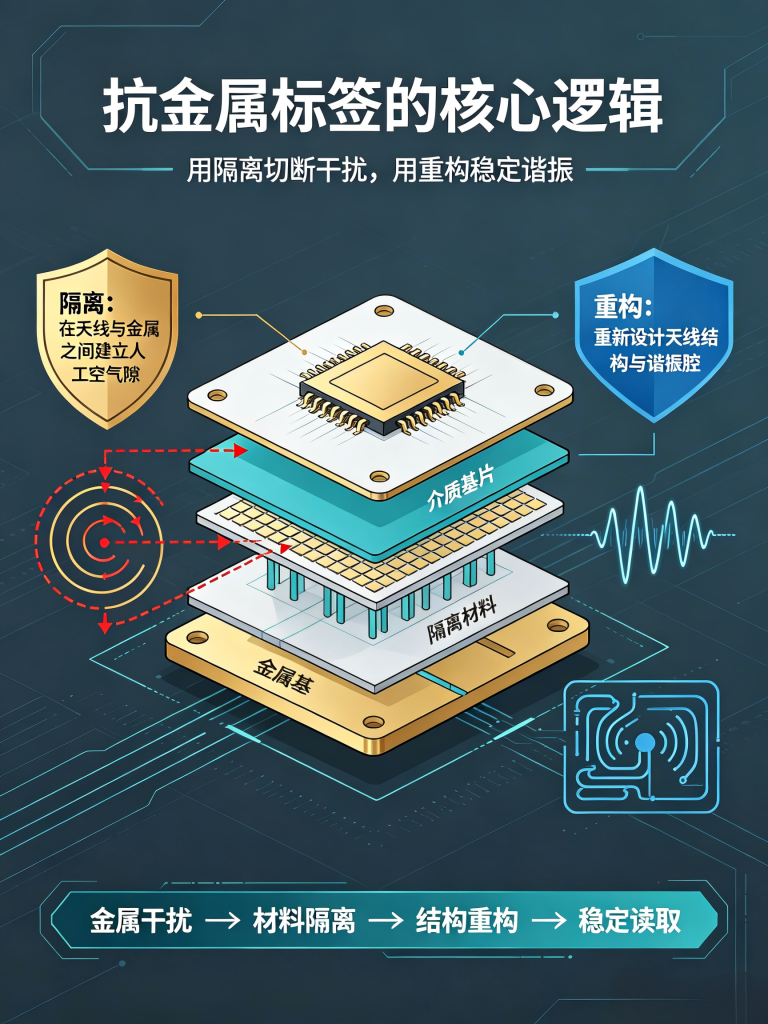
To combat interference from metals, metal mount tags have undergone revolutionary improvements in materials and structure. Their core logic lies in"isolation"and"reconstruction.
1. Isolation layer: Introducing an "artificial air gap"
This is the most intuitive method. By filling a layer of material with high magnetic permeability or low dielectric constant between the antenna and the metal substrate, the distance between the antenna and the metal is artificially increased, thus blocking the path of eddy currents
Commonly used materials:ferrite, microwave absorbing materials, foam or air layer.
• Principle: Ferrites have high magnetic permeability, which can guide magnetic lines of force to bypass metal, just like building a "magnetic wall" between the label and the metal.
2. Microstrip Patch: Structural Reconstruction
This is the mainstream design for high-frequency (HF) and ultra-high-frequency (UHF) anti-metal tags. It designs the antenna as a metal patch separated by a dielectric substrate
• Principle: The distance between the antenna and the ground plane (i.e., the surface of a metal object) is controlled by the thickness of the dielectric substrate, forming a stable resonant cavity. This design not only suppresses eddy currents but can also sometimes utilize the metal surface as a reflective surface to enhance signal gain in specific directions.
3. Special coil winding: guiding the magnetic field
For high-frequency (13.56MHz) applications, some anti-metal tags employ special coil winding processes and structures (such as ferrite lamination) to optimize the magnetic field distribution, enabling them to maintain a high Q value (quality factor) even in metallic environments
III. WELLAUTO Solution: Full-Stack Advantages from Principles to Implementation
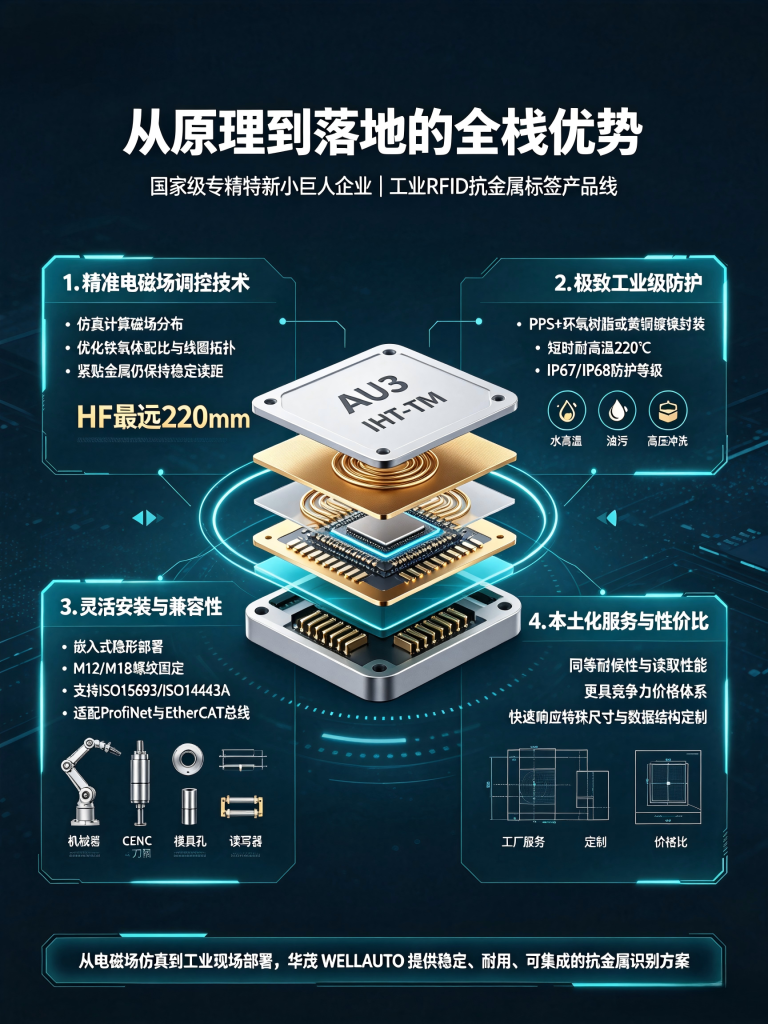
After understanding the complex electromagnetic principles, how do you choose a product that can truly withstand the test of industrial environments? WELLAUTO (WellAuto), a national-level specialized and innovative "little giant" enterprise, has designed its industrial RFID tag product line specifically to address the aforementioned pain points related to these principles
1. Precise electromagnetic field control technology
WELLAUTO'sAU3 IHT-TM series ofhigh-frequency anti-metal tags are not simply "thickened and raised". Their R&D team used simulation software to accurately calculate the magnetic field distribution on the metal surface and optimized the ferrite material ratio and coil topology.
• Advantages: Even when in close contact with stainless steel or aluminum alloy surfaces, it can maintain a stable reading distance (up to 220mm in the HF band), effectively suppressing energy attenuation caused by eddy currents.
2. Ultimate industrial-grade protection
To address the environmental interference mentioned in the principle,WELLAUTOlabels employ an integrated encapsulation process using PPS + epoxy resin or nickel-plated brass
• High temperature resistance: Some models can withstand short-term high temperature impacts up to 220℃, making them perfectly suited for baking lines and heat treatment processes in painting workshops.
• High protection level: Generally meetsIP67/IP68protection standards, is not afraid of cutting fluid, oil stains and high pressure washing, and solves the problem of ordinary labels peeling off and failing in oily environments.
3. Flexible installation and compatibility
Considering the complexity of industrial site installations, WELLAUTO offers a variety of mechanical structure designs:
• Embedded: It can be embedded inside metal workpieces to achieve "invisible" deployment without affecting the robotic arm's retrieval.
• Threaded/screw fastening: For scenarios such as CNC tool holders and mold positioning holes, standard threaded interfaces such as M12/M18 are provided to ensure that the machine will not loosen under long-term vibration.
• Protocol compatibility: Fully supports mainstream protocols such as ISO15693/ISO14443A, and works withWELLAUTO's own reader (supporting buses such as ProfiNet and EtherCAT) to achieve seamless integration from the perception layer to the control layer.
4. Localized service and cost-effectiveness
Compared to similar high-end anti-metal tags from abroad, WELLAUTO offers a more competitive pricing system while ensuring equal or even better weather resistance and reading performance, and can quickly respond to customers' customized needs (such as special sizes, writing special data structures, etc.)

Related Articles