
The AU7 500E series is used in integrated photovoltaic degumming and cleaning machines
Solution November 5, 2025
As early as 1839, French scientist Becquerel discovered that light can create a potential difference between different parts of a semiconductor material. This phenomenon was later called the "photovoltaic effect." In 1954, the United States produced the first practical monocrystalline silicon solar cell, giving birth to practical photovoltaic power generation technology that converts sunlight into electrical energy
Thanks to the safety, reliability, and high energy quality of photovoltaic power generation technology, the photovoltaic equipment industry achieved an installed capacity of 887 million kilowatts in 2024, accounting for approximately 26.3% of my country's total installed capacity. During the long-term operation of photovoltaic equipment, slurry deposits can accumulate on the surface of the silicon wafers. To reduce damage to the silicon wafers caused by human error, integrated degumming and wafer cleaning machines can solve this problem
Process Flow
① Pre-cleaning and degumming process flow:
The silicon wafers are sprayed to remove most of the impurities such as mortar, silicon powder, and metal powder adhering to their surface. Then they enter the degumming tank for degumming. Finally, the silicon wafers and the substrate are separated by degumming using high-temperature lactic acid softening adhesive
② Blade cleaning process
The process involves using water flow to separate the wafers, then feeding the wafers into baskets, and using alkaline and acidic reagents in conjunction with ultrasound to remove impurities such as organic matter, microparticles, and metal ions from the surface of the wafers at a specific temperature, thus achieving integrated wafer debonding, insertion, and cleaning
Solution
The photovoltaic debonding and cleaning production line is relatively long, with a large number of I/O points that need to be controlled and the signals are scattered. Based on the actual situation, the customer chose our AU7 500E series solution, which connects the expansion module via network cable
Application effect
Reduce production costs
The AU7 500E series modules can be distributed over long distances, allowing customers to install them conveniently at the electrical cabinets of their respective workstations, reducing the wiring costs for electricians
The AU7 500E series modules transmit the status of each expansion module to the host. In the event of bus errors or power failures, the problem can be analyzed based on the module status, thereby reducing troubleshooting and downtime
Related Articles
RFID Applications in RGV Vehicles in the Logistics Industry
October 13, 2025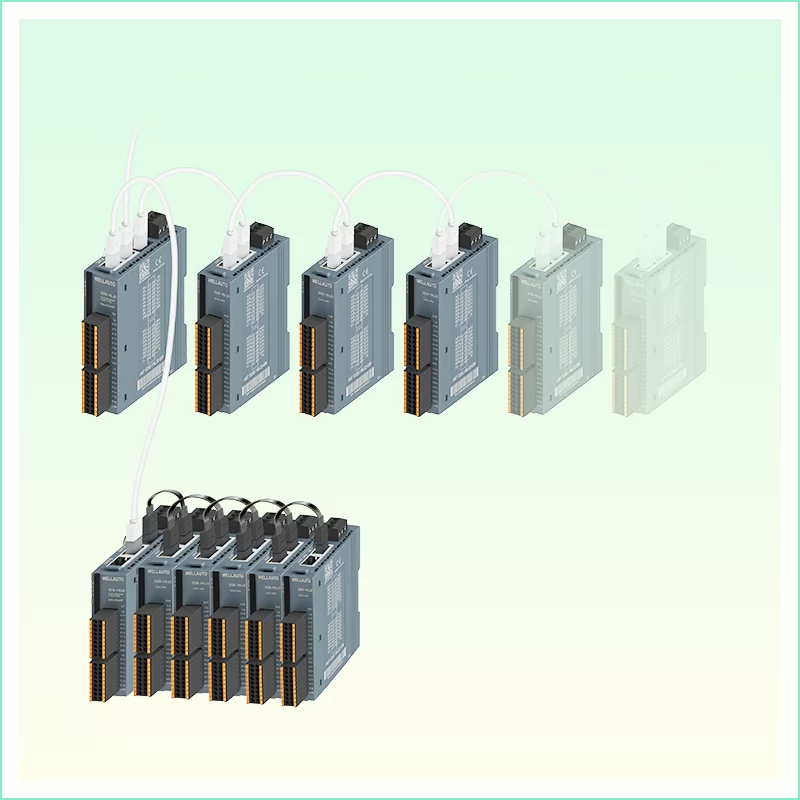
Application of card-type I/O modules in carton filling machines
November 5, 2025