Bus temperature controllers are used in automotive battery riveting equipment
Solution November 5, 2025
The global new energy vehicle market is expanding rapidly, and technology is iterating at a breakneck pace. Today, the performance of pure electric vehicles is already remarkable, with some models even rivaling traditional sports cars. As range anxiety gradually eases and charging infrastructure becomes increasingly sophisticated, people are paying closer attention to: how much development potential does the new energy vehicle market still hold? And where exactly are the technological ceilings in this field?
As the "heart" of new energy vehicles, the performance optimization of automotive batteries is crucial. To achieve this, three core requirements must be met: compact battery structure design, high-precision component machining, and reliable electrical connections and mechanical fastening. Riveting equipment, through high-precision and high-stability connection processes, ensures a stable and reliable connection between electrodes and other components, effectively avoiding problems such as loose connections and loosening, thereby guaranteeing the overall performance and safety reliability of the battery system
Automotive battery riveting process
Electrode and busbar welding: Stack the electrode and busbar together and apply pressure to fix them in place. Then apply current (resistance welding) or laser/ultrasonic energy to weld. Finally, test the weld strength and conductivity
Battery cover welding (sealing welding): Laser welding is performed using parameters such as laser power and speed. After welding, the battery must ensure that the weld is free of pores and cracks and meets the airtightness requirements
Module/Pack welding: When connecting batteries in series or parallel, weld copper/aluminum connecting pieces
Solution
Automotive battery riveting equipment requires precise temperature regulation to maintain the battery within a certain temperature range during riveting, and the temperature difference between modules needs to be controlled within ±5℃ to ensure thermal balance management
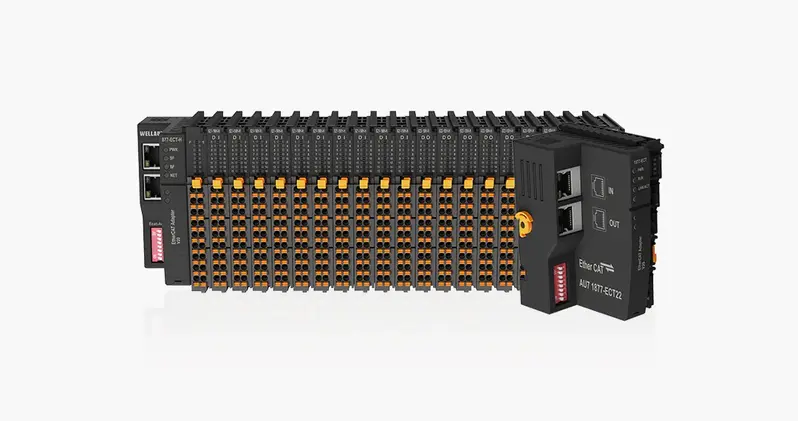
WELLAUTO 's AU7 697H-0RD22-PNT is a high-capacity, highly integrated temperature controller with up to 40 temperature control channels, meeting the temperature control requirements of battery riveting equipment
Application effect
Reduce costs
The bus temperature controller has an embedded intelligent PID temperature control algorithm, eliminating the need for PID programming, effectively shortening the setup time, and is not limited by the host PID capacity, thus maximizing the host's functionality
Rapid response, energy efficiency optimization
The bus temperature controller channel features 50ms fast data acquisition, resulting in more efficient temperature control and ensuring the battery can be riveted within the optimal temperature range