
WELLAUTO – Penetrating Oil and Dust: How Industrial High-Frequency RFID is Reshaping Production Line "Sensing Capabilities"
Solution June 4, 2026
WELLAUTO
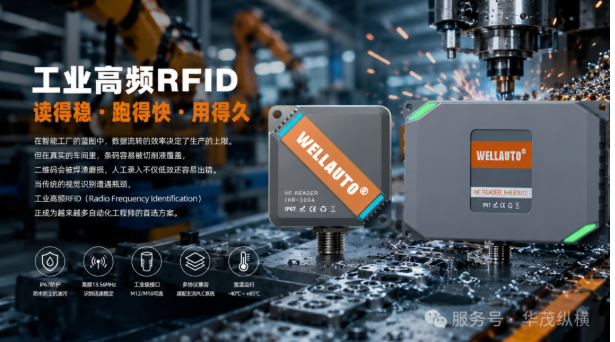
In the blueprint of a smart factory, the efficiency of data flow determines the upper limit of production. However, in real workshops, barcodes are easily covered by cutting fluid, QR codes are worn away by welding slag, and manual data entry is not only inefficient but also prone to errors. As traditional visual recognition encounters bottlenecks,industrial high-frequency RFID (Radio Frequency Identification)is becoming the preferred solution for more and more automation engineers.

It doesn't rely on "seeing," but on "sensing." Industrial high-frequency RFID operates in the globally common 13.56MHz ISM band, usinginductive couplingfor communication—like a miniature transformer: when the reader antenna is energized, it generates an alternating magnetic field. When the code carrier enters the magnetic field, it induces a current through the coil, thus activating the device. The stored data is then modulated by the load and transmitted back to the reader. Because it is based on near-field magnetic coupling rather than far-field electromagnetic radiation, the magnetic field is not easily shielded by water or oil, and the reading boundary is clear, avoiding the "cross-reading" that occurs with ultra-high frequency (UHF) RFID, making it ideal for precise identification at the workstation level.
When discussing high-frequency RFID, the ISO international standard is indispensable . In the mid-1990s, the International Organization for Standardization (ISO/IEC) successively formulated two core specifications for the 13.56MHz band: ISO/IEC 14443 (close-coupled standard), drafted in 1995 and officially released in 2000, typically has a reading distance of less than 10cm and is divided into Type A (commonly used for public transport cards/access control) and Type B (CPU cards such as second-generation ID cards), offering extremely high security; ISO/IEC 15693 (loose-coupled standard), drafted in 1997 and released in 2002, requires only about 1/10 of the activation field strength of the former, theoretically achieving a reading distance of 70-100cm or more, and supports multi-tag anti-collision, making it the mainstream standard for pallet tracking in industrial production lines. Furthermore, ISO/IEC 18000-3 further defines the physical layer and anti-collision algorithm for this band, ensuring interoperability between devices from different manufacturers.
The core of a mature high-frequency RFID system lies inthe hardware architecture of the reader. A typical industrial-grade reader consists of four main modules:the RF front-end (RF Module)is responsible for generating a 13.56MHz carrier and conditioning the antenna circuit, maximizing coupling efficiency through impedance matching;the main control unit (MCU/DSP)runs a complex protocol stack, managing the ISO 15693/14443 anti-collision algorithm and data encoding and decoding;the interface unitprovides industrial buses such as RS485, IO-Link, or ProfiNet, enabling seamless integration with PLC/MES;the power supply and protection circuitsensure the stability of the device under a 24V industrial power supply, providing reverse connection protection, overvoltage protection, and ESD surge suppression capabilities.
It is precisely because of this technological foundation that high-frequency RFID has found an irreplaceable position in the manufacturing industry. In CNC machining centers, it monitors tool life in real time to prevent tool collisions; in automobile assembly lines, it enables workstations to automatically identify vehicle models and call the corresponding tightening programs; in flexible logistics lines, it allows AGVs to know the ownership of orders on pallets
Of course, even the best technology needs robust hardware to support it. In industrial settings, readers not only need to be "smart," but also "robust."
This is precisely the original intention behind WELLAUTO 's launch of the AU3 IHR series high-frequency readers . We not only make communications products, but we also understand industrial environments.

WELLAUTOreaders were designed with the harshest operating conditions in mind from the outset, boasting an IP67/IP68 protection rating across the entire series , capable of withstanding high-pressure water washing and cutting fluid immersion. Built-in comprehensive reverse connection, overvoltage, and ESD surge protection ensures worry-free long-term operation. In terms of performance, they support high-speed read and write speeds up to 1500 Bytes/s , and are compatible with ISO15693, ISO14443A/B, and NFC protocols, meeting needs ranging from simple ID recognition to complex process parameter interaction.
To meet different installation needs, we offer a wide range of form factors to choose from:
•Compact cylindrical type (AU3 IHR-3001 / 3002): M18/M30 threaded integrated type, with built-in induction antenna, like a sensor, plug and play, suitable for machine stations with limited space.
•All-inhigh-performance model (AU3 IHR-3004 / 3006 / 3011): All-in-one antenna with a reading distance of 100~220mm. The network port version supports PoE power supply, and a single network cable solves both signal and power needs, resulting in extremely neat cabling.
•分体Split-type high-performance model (AU3 IHR-3007): Supports external antenna, with a reading distance of 100~220mm.
Regardless of whether you are using Siemens, Omron, Mitsubishi, or Rockwell (AB) PLCs on-site, the AU3 IHR series can be seamlessly connected via ProfiNet, EtherNet/IP, EtherCAT, CC-Link IE, and IO-Link , allowing data to directly reach your MES system.
Industrial upgrading begins with advanced sensing. Choosing WELLAUTO high-frequency RFID readers means choosing a more stable and efficient digital future

Related Articles
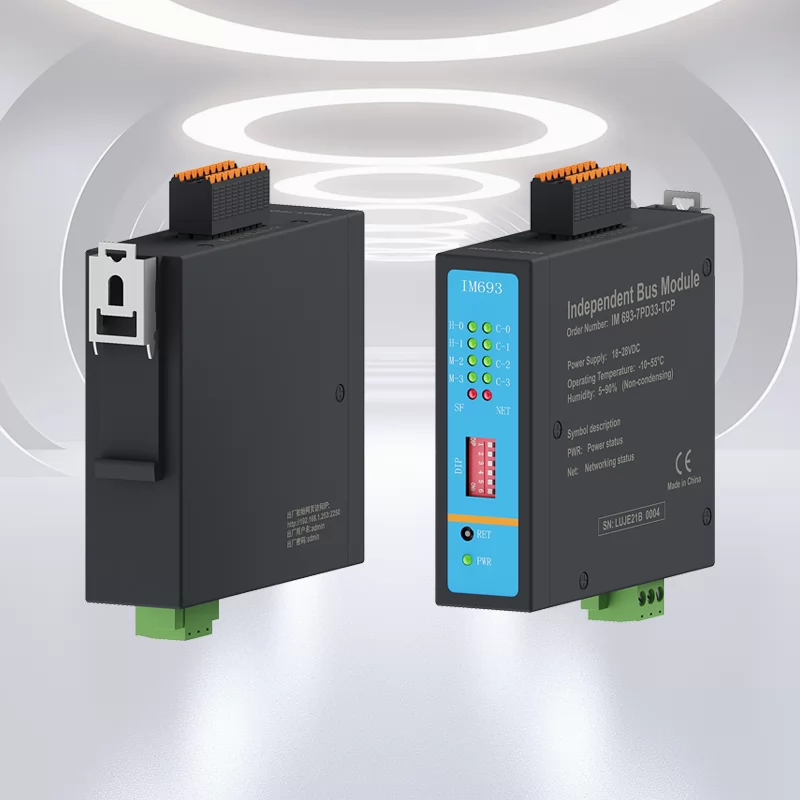
Bus temperature control is used in hot riveting machines
November 5, 2025
![[Application Case] IO-LINK four-level expansion applied to lithium battery pack module lines](https://www.wellauto.net/wp-content/uploads/2026/01/2026010609063157.png)