[Application Case] IO-Link solution applied to automotive seat assembly line
Solution March 13, 2026
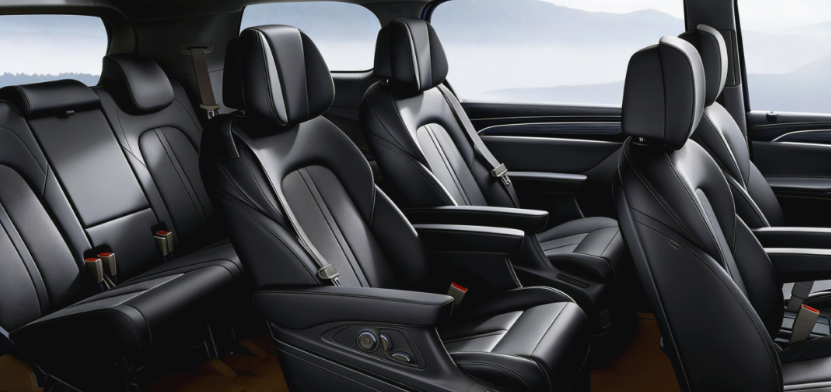
As the core seating device for drivers and passengers, car seats not only need to provide a comfortable riding experience but also ensure driving safety throughout the entire driving process. They are mainly composed of key components such as foam padding, backrests, safety locks, and headrests, and are a core embodiment of automotive safety and comfort
In the current automotive market, cost reduction and efficiency improvement have become core industry demands, and automotive seat design is also moving towards "simplified structure, iterated materials, and upgraded processes." While balancing seat comfort, safety, and intelligence, the core upgrade goal of seat assembly lines is to streamline components through technological optimization, thereby improving product strength and usability
Process Flow
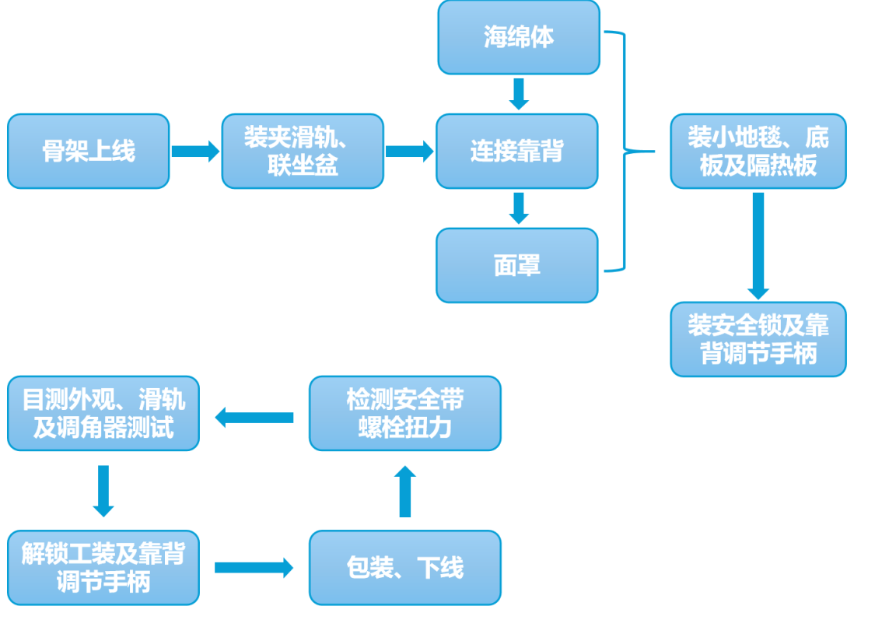
The car seat assembly process is rigorous and orderly, ensuring that every component is precisely fitted. The specific process is as follows: First, the seat frame is installed, and the slide rails and seat pan are completed. Then, the foam and seat cover are fixed to the backrest to build the basic shape of the seat. Next, the small carpet, base plate and heat insulation plate are installed in sequence to complete the initial assembly of the seat. Finally, the safety lock and backrest adjustment handle are installed, the torque of the seat belt bolts is precisely tested, and a comprehensive test of the appearance, slide rails and adjusters is carried out. After packaging, the seat is ready to be taken off the production line
After rolling off the production line, the car seats must undergo comprehensive testing to rigorously inspect and evaluate their overall performance and components, ensuring that the quality and performance of the seats meet industry standards and design requirements throughout the process
Solution
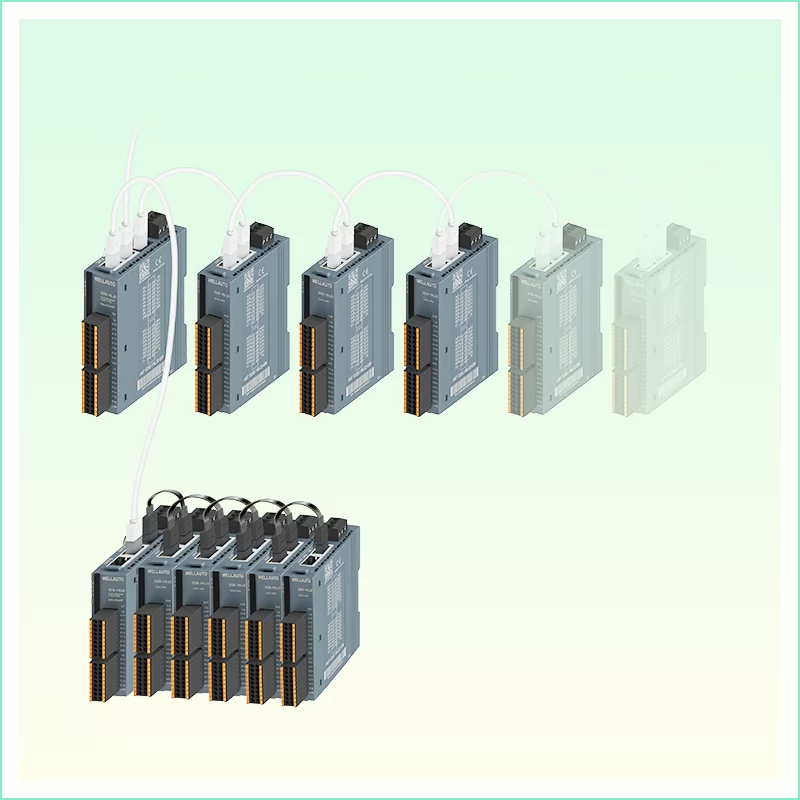
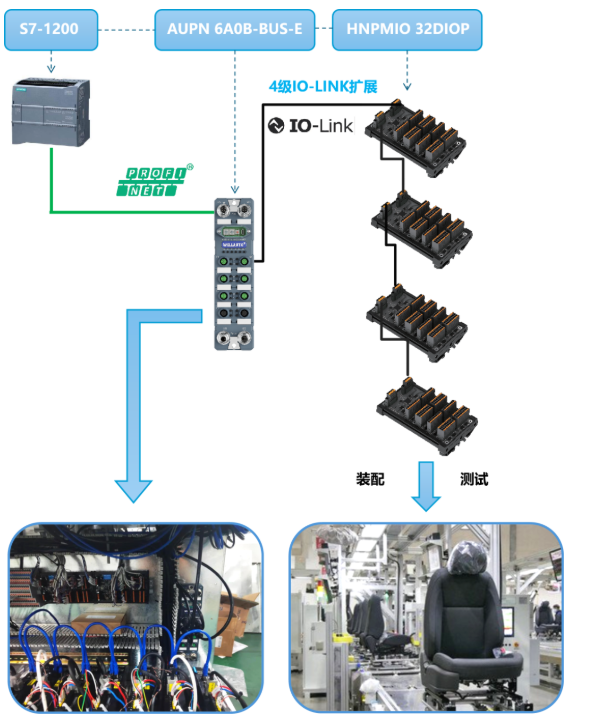
To address the precision and efficiency requirements of automotive seat assembly lines, this case study utilizes a Siemens PLC 1200 as the control core.Through the Profinet-RT bus protocol, it achieves stable connections withWELLAUTOAUPN 6A0B-BUS-E IO-Link master module and the HNPMIO 32DIOP IO-Link slave module, thus constructing a highly efficient and collaborative control system.
The AUPN 6A0B-BUS-E and HNPMIO 32DIOP will perform various assembly and testing tasks according to the preset program of PLC S7-1200, while monitoring the position, angle and other signal information of the seat in real time and transmitting it to the controller to ensure the accuracy and real-time performance of the assembly
Furthermore, the AUPN 6A0B-BUS-E master module can read core data such as fault events and lifespan of slave modules, actuators, and sensors in real time via the IO-Link protocol, enabling transparent data management of production line equipment. By predicting the lifespan of IO-Link slave modules, replacement and maintenance can be performed in advance, effectively reducing production line downtime and improving assembly efficiency
Application effect
1
Easy to install, compact size, and cost-effective
Compared to other brands' IO-Link slave modules, the HNPMIO 32DIOP is smaller in size with 32 points. The DIO uses an adaptive method, requiring no configuration and making operation simpler. The module comes with built-in sensor wiring, which is easy to connect and saves on terminal and cable costs
2
Strong scalability, adaptable to long production lines
The AUPN 6A0B-BUS features the world's first IO-Link four-level expansion and can also expand to 32 AUBO modules via the WellAUBUS backplane protocol and two B-Code interfaces, with a maximum expansion length of 300 meters, which is suitable for field applications with long pipelines and reduces customers' wiring costs

Related Articles
![[Application Case] IO-Link solution applied to automotive seat assembly line](https://www.wellauto.net/wp-content/uploads/2026/03/2026041403585414.png)