Application Case】The IO-Link solution is applied to the NIC production line for new energy vehicle inverters
Solution March 23, 2026
Inverters are the "heart" of the power system in new energy vehicles. Their efficient DC-AC conversion, precise motor control, and energy recovery functions act like the pumping function of the heart, playing a crucial role in ensuring the stable operation, range, and power performance of electric vehicles
The new energy vehicle inverter NIC assembly line includes complex processes such as robotic assembly stations, automatic screw tightening systems, press-fitting equipment, automatic dispensing/applying equipment, power module mounting equipment, welding equipment, and testing equipment. A highly automated, high-precision, and highly reliable production and assembly process ensures inverter performance
Pain points and challenges
Pain Point 1: Lack of transparency in information and delayed fault response
Traditional sensors and actuators lack self-diagnostic capabilities, making it impossible to provide early warnings of their lifespan or potential failures. Once an anomaly occurs, the production line is forced to halt for thorough troubleshooting, severely impacting production cycle time and OEE (Output Effectiveness)
Pain Point 2: Limited installation space and complex wiring inside the cabinet
Traditional I/O modules rely on installation within control cabinets, which not only occupies cabinet space but also leads to lengthy and costly field cabling. In workstations where metal spatter is present, such as welding and pressing processes, conventional equipment is difficult to install nearby
Solution
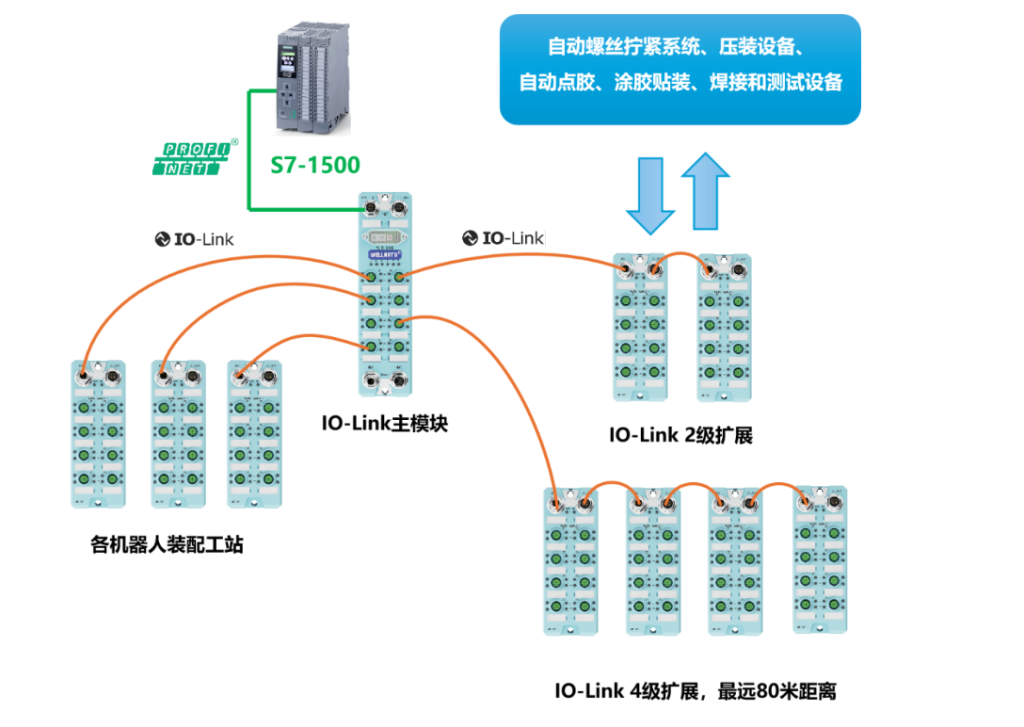
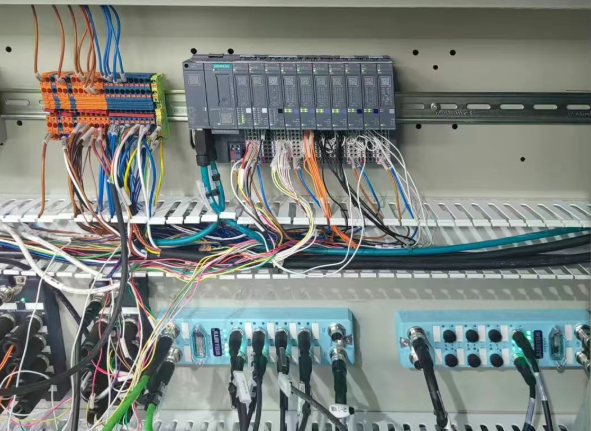
To address the aforementioned pain points, the NIC production line adopts a control architecture based on the Siemens S7-1500 controller and connects to a distributed I/O solution with IP67 protection rating via the Profinet protocol, specifically including:
Highlights
1. Transparent equipment management enables predictive maintenance
- Using the IO-Link protocol, the AUPN 8A0B can read diagnostic data such as lifespan, fault codes, and operating status of compatible sensors and actuators in real time
- Maintenance personnel can use planned downtime to replace components nearing the end of their lifespan in advance, avoiding unplanned downtime; in case of a fault, it can be quickly located, significantly shortening the troubleshooting time
2. IP67 high protection, supports installation near the cabinet
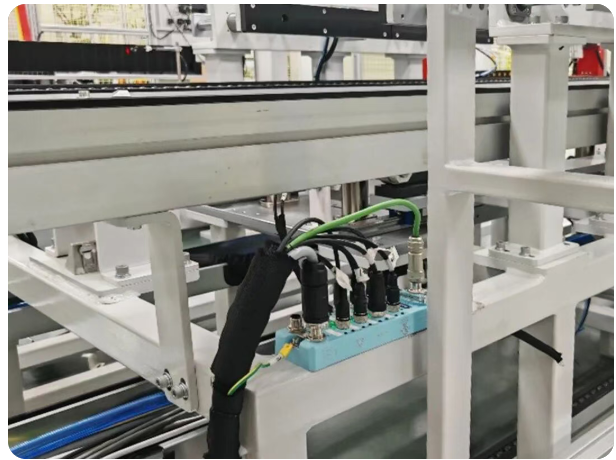
- The module has an IP67 protection rating and can be installed directly on the side of the equipment or next to the workstation without the need for a control cabinet
- With its metal casing design, it can still operate reliably in workstations where metal splashes occur, such as welding and pressing, significantly reducing on-site wiring distance and wiring costs
3. High vibration resistance and flexible wiring, adaptable to complex processes
- The AUPN 8A0B and AUIO 16DIOP-T modules have excellent vibration resistance and are suitable for dynamic load scenarios such as robot assembly and press-fitting
- It is equipped with highly flexible cables to meet the wiring needs of moving parts and confined spaces, ensuring long-term stable operation of the system
4. World's first four-level IO-Link cascading system, optimizing networking costs
- It supports 4-level IO-Link cascading expansion, with a maximum single-channel transmission distance of up to 80 meters
- In large-scale production lines, it can significantly reduce the number of IO-Link master modules, lower hardware and cabling costs, while maintaining the flexibility of system expansion, resulting in outstanding cost-effectiveness
Related Articles
Card-type I/O modules are used in pulp film cleaning lines
November 5, 2025