Analysis of the technical principles and differences in types of high-frequency RFID antennas: From 13.56MHz near-field coupling to WELLAUTO industrial solutions
Solution September 18, 2026
I. Introduction
In scenarios such as intelligent manufacturing, automobile assembly, CNC tool management, and 3C precision assembly, RFID is no longer just "access card technology," but rather the "first point of contact" in the industrial data link. Among them,high-frequency RFID (HF, 13.56MHz) has become one of the main frequency bands in industrial identification due to its relatively friendly nature to metal environments, mature protocols, and stable short-range identification.
However, many engineers fall into a trap when selecting a product:
Choosing an HF RFID antenna as if it were a UHF antenna—looking at the gain, polarization, and radiation pattern—resulted in problems such as the antenna not reading when attached to metal, failing to read when placed in machine tools, and missing readings on the production line.
This article explains the principles in a systematic way:
1. How exactly does an HF RFID antenna work?
2. What are the common types of HF RFID antennas?
3. What are the essential differences between different antennas?
4. WELLAUTO 's Engineering Advantages in HF RFID
II. The essence of HF RFID: It does not "transmit radio waves," but rather "couples magnetic fields."
UHF RFID operates around 800/900MHz, and its energyemitted by electromagnetic waves.
HF RFID operates at 13.56MHz , and energy is mainly transferred in the near-field sensing area
The reader antenna is essentially amulti-turn loop coil, and the tag also contains a small coil. Together, they form an "air-core transformer."
• The reader supplies a 13.56MHz alternating current to the coil, thereby generating an alternating magnetic field
• The tag enters the magnetic field → The tag coil induces an electromotive force → Powering the chip
• The tag modulates the magnetic field via load modulation → The reader decodes the data
Therefore, the key parameter for an HF antenna is not "dBi gain", but rather:
• Coil inductance L
• Resonant capacitor C (LC resonant at 13.56MHz)
• Q value (energy intensity vs. bandwidth)
• Coil area, number of turns, wire width
• Distance from metal/liquid/casing
• Impedance matching (reader output ↔ antenna ↔ environment)
In short: an HF antenna is an "inductive element + resonant circuit + near-field coupling structure", not a radiating antenna in the traditional sense
III. Main Types of High-Frequency RFID Antennas
1. PCB Etched Coil Antenna
Spiral loops are etched from copper foil onto FR-4, aluminum substrates, or epoxy boards, which is the most common form of card readers, industrial read/write heads, and payment terminals
advantage
Good batch consistency
Low cost
• Can be integrated with reader/writer circuitry
Suitable for access control, workstation readers, and industrial RFID readers
shortcoming
• If metal is placed too close, the inductance and resonant point are prone to drift
• Do not bend
High current/high power applications are limited by copper thickness and heat dissipation
Typical reading distance
• Onboard small coil: a few centimeters
• 60×60mm readhead: 10–16cm
• External large coil: up to tens of centimeters
2. FPC/PET Flexible Etched Antenna
Copper or aluminum foil spirals are fabricated on films such as PET and PI, commonly used in cards, wristbands, mobile phone NFC, and medical tags
advantage
Thin, lightweight, and adaptable to curved surfaces
Suitable for consumer electronics, receipts, and asset cards
• Good adaptability to irregularly shaped shells
shortcoming
• General mechanical strength
• Prolonged bending will change the resonance
Short lifespan due to industrial oil contamination, high temperature, and high pressure washing environments
3. Wire-wound copper coil antenna
The coil is made by winding enameled copper wire into a loop and then fixing it with a frame, glue, or injection molding
advantage
• The Q value can be high, resulting in strong near-field energy
• Flexible shape, suitable for non-standard reader heads and custom labels
• Commonly used in industrial tool holders, molds, and non-standard equipment
shortcoming
Automation costs are higher than PCB costs
• The tightness of the winding directly affects the inductance
• Batch consistency depends on process
4. Ferrite anti-metal antenna
Add a ferrite sheet between the coil and the metal, or use a ferrite core to concentrate the magnetism, and then redesign the LC resonance
Why must it be this way?
Eddy currents are generated on the surface of a metal , and these eddy currents produce a reverse magnetic field. The result is:
• Changes in coil inductance
• Resonant frequency shift
• Energy is consumed
• Completely unreadable after applying metal
The role of ferrite is to provide a low magnetic resistance path for magnetic field lines, "pressing" the magnetic field to one side of the label, while isolating metal eddy currents
advantage
Suitable for application on stainless steel, aluminum alloy, machine tools, tool holders, and molds
• One of the most practical types of HF antennas in industrial settings
• Reading distance and stability are far superior to ordinary coils
shortcoming
• Higher cost
• Increased thickness
• Ferrite composition, coil topology, and packaging must be simulated together
5. High-power external loop antenna
Connects to an external large-size square or round coil via an SMA/M12 interface, driven by a 1–4W industrial reader/writer
advantage
• Large coverage area
Suitable for assembly lines, pallets, tooling, and multi-label applications
• Large tolerance for label angle and position
Key points
• 13.56MHz tuning is required
• If there is metal on the back, leave a gap or add a magnetic sheet
• When multiple antennas are arranged in parallel, it is necessary to prevent mutual coupling and crosstalk
6. Miniature industrial antennas (Φ12 / Φ18, etc.)
Minimal toroidal coil + high permeability/high dielectric material assistance + fine matching, for tool holders, electrodes, and 3C parts
advantage
Small size and concentrated electric field
• Can be embedded in mechanical structures
Suitable for carriers with extremely limited space
difficulty
• Packaging of inductors has a significant impact
• Extremely high requirements for tuning and materials
It's not as simple as a "miniature version of a large antenna"
IV. Comparison of Differences Among Various HF RFID Antennas
Core principle:
Larger coil → wider magnetic field coverage → longer reading distance
The closer the metal is, the more severe the detuning becomes; isolation/anti-metal protection is necessary
A higher Q value indicates higher energy but a narrower bandwidth
A lower Q value indicates greater stability but shorter read distance
V. Five common pitfalls in HF RFID antenna selection
1. Use the UHF approach to select HF: look at the gain, polarization, and radiation pattern, and ignore inductance and near-field coupling in the results.
2. Antenna directly attached to metal: without adding ferrite or leaving an air gap, the reading range is halved or even reduced to zero.
3. Only look at the nominal reading distance: label angle, material, speed, multiple labels, and shell will all change the result.
4. Without impedance matching: at 13.56MHz, even a slight difference in L/C will result in significant reflection.
5. Consumer-grade antennas for industrial use: They are rendered unusable by cutting fluid, oil, vibration, and high temperatures.
VI. WELLAUTO 's HF RFID Advantages
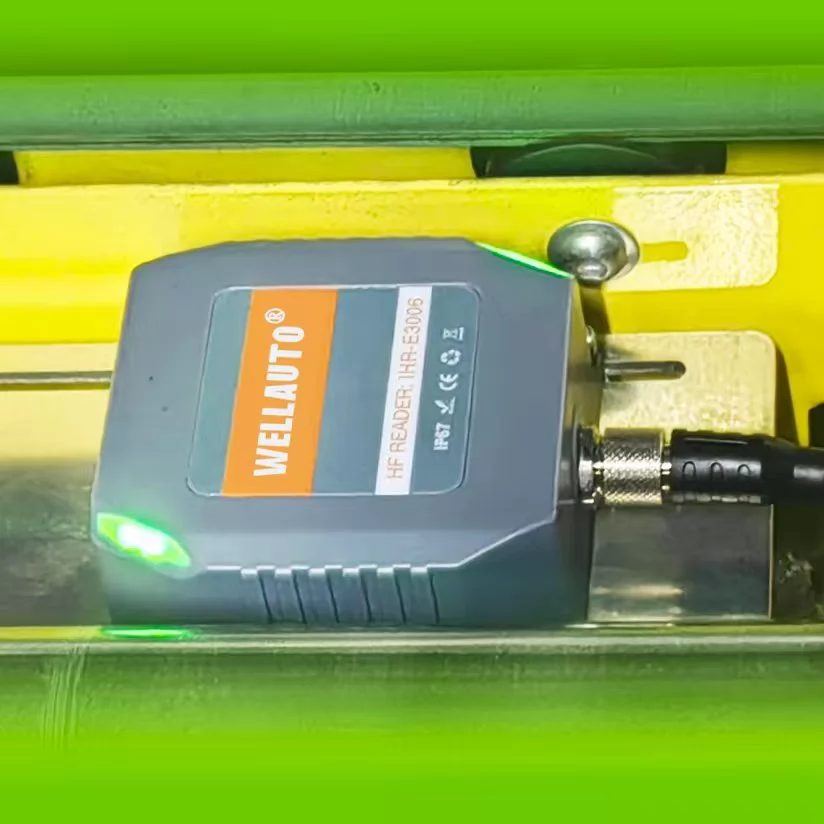
WELLAUTOdoesn't just sell "a card reader module," but providesindustrial-grade HF RFID systems:
Reader + External Antenna + Anti-metal Tag + Industrial Bus + Operating Condition Verification
1. Comprehensive antenna size coverage: from Φ12mm to large industrial antennas
WELLAUTO offers:
• Φ12 / Φ18mm ultra-small antenna: suitable for 3C assembly, CNC tool holders, and electrode management.
• Large external antenna: Suitable for assembly lines, fast-moving objects, variable angles, and multi-tag reading, reducing missed reads.
Many manufacturers only have onboard small coils; WELLAUTO is able to integrate "miniature identification" and "production line coverage" into the same product system
2. Anti-metal is not "foam padding," but rather electromagnetic field reconstruction
WELLAUTOAU3 IHT-TM Series HF Anti-Metal Label:
• Optimize ferrite composition and coil topology through magnetic field simulation
It can still work stably even when covered with stainless steel/aluminum alloy
• HF anti-metal reading distance up to 220mm
• Some labels are IP67 / IP68
• High-temperature models can withstandshort-term impacts up to 220°C.
This is not simply about raising the bar; it's about engineering from the perspectives of eddy current suppression and resonant reconstruction
3. Native industrial bus, unlike "serial port devices"
WELLAUTO HF reader supports:
· ProfiNet
EtherCAT
EtherNet/IP
Modbus TCP
IO-Link
Furthermore, RFID data can be mapped to the PLC image area, allowing tags to be read like I/O
For automobiles, 3C products, CNC machines, and smart warehousing, this is much more reliable than "host computer polling the serial port"
4. Speed and stability are designed according to production line cycle time
• Effective data rate up to1500 Bytes/s
• Single read time: 20–50ms
• Single write cycle 50–150ms
• Adaptive tuning: Dynamic correction when near metal, temperature changes, or workpiece material switching
Typical returns:
• CNC tool change recognition speed improved from 500ms to 30ms
• The missed read rate has been reduced to below 0.01%
• Power battery module assembly enables high-speed, stable multi-tag group reading
5. Industrial packaging and localization services
WELLAUTO label is commonly used:
• PPS + epoxy resin
• Integrated brass nickel-plated packaging
Capability Coverage:
• Operating temperature: -40~100℃
• Some models can withstand short-term high temperatures up to 220℃
• Cutting fluid, oil stains, high-pressure flushing environment
• M5 / M6 / M10 threaded, embedded, coin-shaped, miniature code carrier
As a national-level specialized and innovative "little giant" enterprise, WELLAUTO has R&D, manufacturing, and service systems in South China, East China, and Guilin. Compared with high-end RFID solutions from abroad, it can provide better cost performance and faster customization response with the same weather resistance and reading performance