Cracking the "Magnetic Field Code" of High-Frequency RFID: The Size Game Between Antennas and Tags and the Truth About Sensing Distance
Solution June 18, 2026
In the precise world of industrial automation, RFID technology is often likened to the "touch" of machines. However, in actual selection, engineers often fall into a classic misconception:to increase the sensing distance, is it better to simply make the reader antenna and tag as big as possible?
The answer is no. In13.56MHz industrial high-frequency RFID , the sensing distance (coupling distance) is not a simple linear superposition, but a complex balance determined byinductive coupling. Today, we'll start from the underlying principles, dissect the "love-hate relationship" between antenna and tag size, and seeWELLAUTOnavigates this magnetic field game with ease.
I. In-depth analysis of the principle: Mutual inductance coefficient (k) determines fate
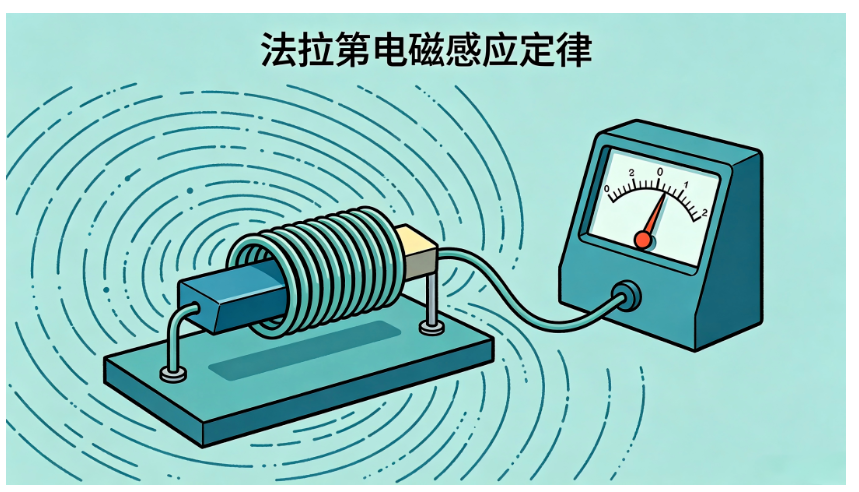
High-frequency RFID does not use electromagnetic radiation; instead, it utilizesFaraday's law of electromagnetic induction. We can consider the reader coil and the tag coil as two inductive coils placed close together.
The key parameter determining whether two entities can "communicate remotely" is calledthe mutual inductance (M). The formula can be simplified to:
M = k × √(L₁ × L₂)
in:
• L₁ and L₂ are the self-inductance values of the reader coil and the tag coil, respectively .
k(coupling coefficient) , which depends on the geometry, relative position, andsize ratio.
1. The "sphere of influence" of the antenna (reader coil)
A larger reader antenna does indeed generate a wider range of alternating magnetic fields. However, this comes at a cost:
•Q value decreases: Increasing the number of coil turns or increasing the area will lead to an increase in distributed capacitance and a decrease in the quality factor (Q value), which means that the energy density of the magnetic field may actually decrease.
•Edge effect: Excessive magnetic field divergence at the edge of the antenna can easily cause ghost reads.
Therefore, the core of industrial-grade reader antenna design is not "making it bigger", but"making it accurate"- under specific volume constraints, improving the uniformity of magnetic field strength by optimizing the magnetic circuit design.
2. The "appetite" of the tag (code carrier coil)
The larger the tag coil, the more magnetic flux (Φ) it can capture, resulting in a larger induced current and theoretically a longer reading distance. However, there aremarginal effects:
•Physical limitations: In scenarios such as CNC tool holders and miniature bearings, there is simply no space to accommodate large labels.
Impedancematching: Tag chips have their optimal input impedance. If the coil is too large, resulting in excessively high inductive reactance, a complex matching network is needed, increasing cost and reducing sensitivity.
Conclusion: A larger antenna or tag does not necessarily mean a linear increase in distance. The optimal solution lies inthe golden ratio of the antenna and tag coil areas, as well ashigh-quality resonant tuning.
II. Practical Application: Technological Breakthroughs Under Space Constraints
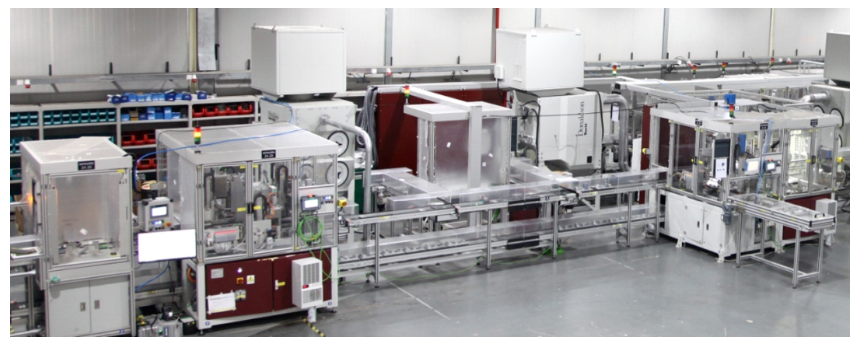
Understanding the principles allows us to make more informed choices on the industrial floor:
·Scenario A: Precision Tool Management
Space is extremely limited (the handle diameter is only Φ6-Φ20mm). Therefore,miniature tags. To compensate for the energy loss caused by the smaller tag size, the reader antenna must employa high Q-value designto concentrate magnetic field energy and ensure tag activation even in extremely small air gaps.
·Scenario B: Pallet/material cart flow
A larger installation space is allowed.Larger anti-metal tagsin conjunction witha flat panel antenna. The large antenna area provides wide magnetic field coverage and can tolerate slight swaying of the tray on the conveyor line, ensuring stable reading.
III. WELLAUTO Solution: Compensating for size with manufacturing processes, conquering the environment with algorithms
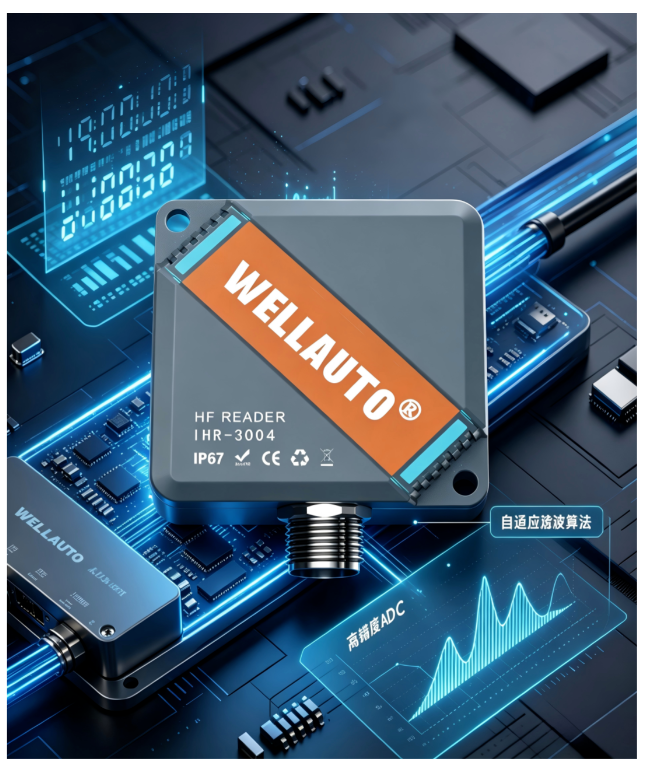
Facing the extreme challenge of "small antenna vs. small tag",WELLAUTO's AU3 IHR series high-frequency reader demonstrates its profound technological foundation.
Instead of blindly pursuing large physical dimensions, we reconstructed magnetic field efficiency within a limited volume through circuit design and algorithm optimization
1. High-sensitivity radio frequency front end
WELLAUTO readers have a built-in high-precision ADC and adaptive filtering algorithm, which can accurately demodulate data from environmental noise even when the tags are extremely small (such as Φ8mm) and the return signal is extremely weak, thus solving the industry pain point of "small tags are difficult to read"
2. Fully industrial-grade protection, regardless of installation environment
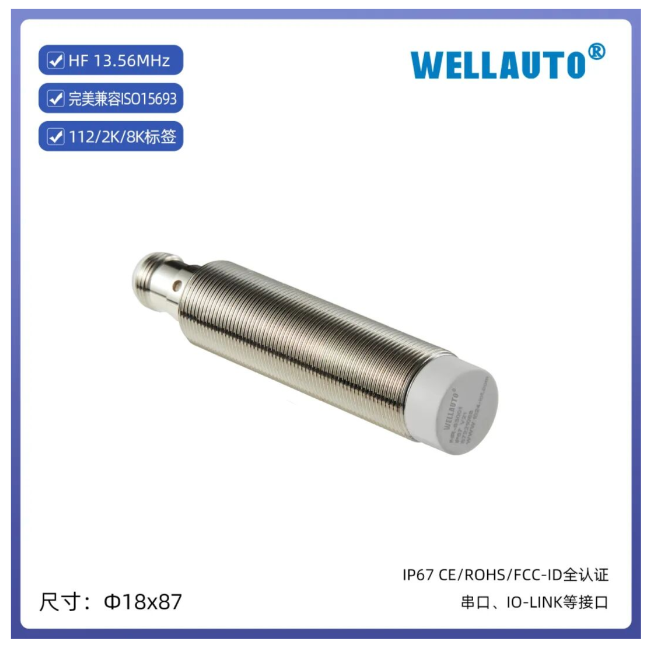
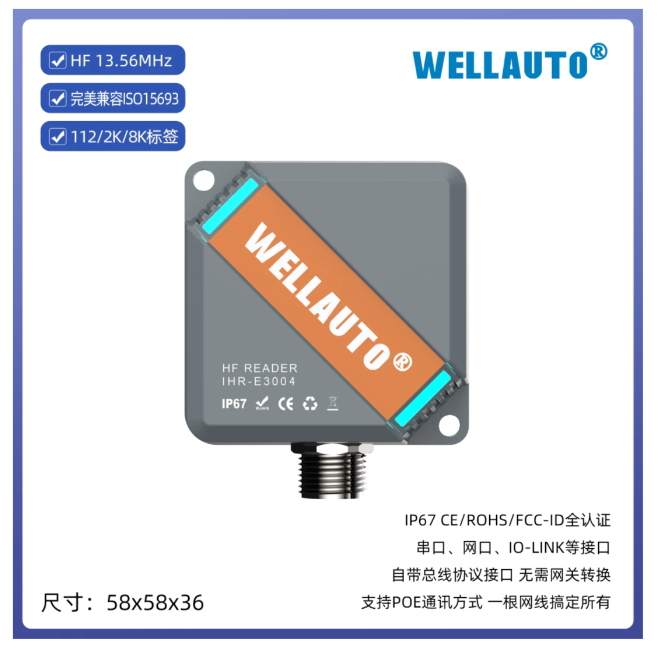
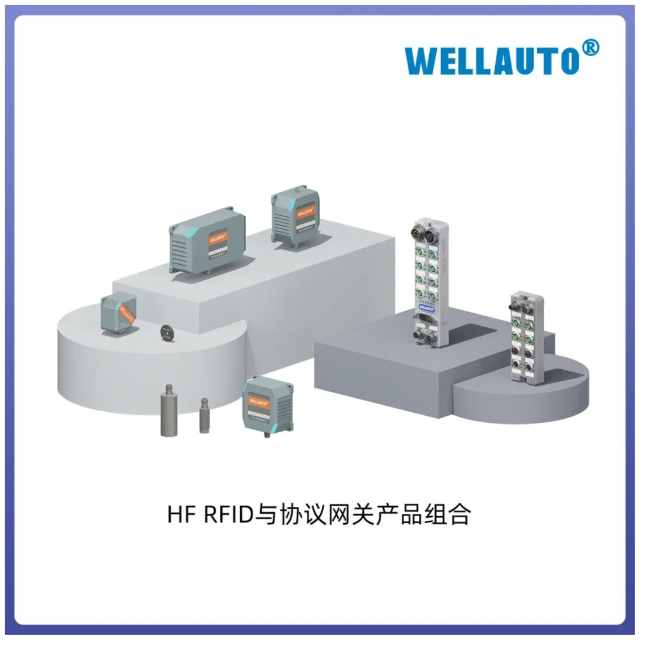
Whether it'sthe Φ18/Φ30mm cylindrical integrated reader (AU3 IHR-3001/3002)orthe split reader supporting external antennas (AU3 IHR-3004/3006), all models adopt IP67/IP68 protection rating. This means that even in metal processing centers filled with cutting fluid and oil, our readers can still stably output 1500 Bytes/s .
3. A flexible combination of "size" techniques
•Compact type: Designed for small workstations, it offers an integrated read/write head with M12/M18 thread mounting, as convenient as a sensor, but with recognition capabilities far exceeding those of ordinary sensors.
• Split type: For large areas, it supports external high-performance antennas, with a maximum vertical detection distance of up to220mm, perfectly covering workstations with large fluctuations such as double-speed chains and lifting transplanters.
4. Seamless integration into the industrial ecosystem
SupportsISO15693 / ISO14443 / NFC protocols, and is compatible withProfiNet, EtherNet/IP, EtherCAT, and IO-Link , allowing RFID data to enter the PLC in real time and reliably, just like a switch signal.
In the world of industrial high-frequency RFID,size is a physical limitation, but technology is the key to overcoming it. By understanding the "magnetic code" of antennas and tags, you gain control over the intelligentization of production lines.
Choosing WELLAUTO means choosing a partner who understands both physical principles and industrial processes

Related Articles